 |
|
| node: | "Scientists achieve X-ray vision with safe, visible light" |
| template: | 4 |
| parent: | Science fetish |
| owner: | dnes nie je moj den |
| viewed by: | |
| created: | 15.02.2015 - 14:47:42 |
| updated: | 15.02.2015 - 14:49:09 |
|
cwbe coordinatez: 101 63533 5211994 7841232 ABSOLUT KYBERIA |
| permissions | |
| you: | r, |
| system: | public |
| net: | yes |
total descendants::0
total children::0
"Early attempts to image solid objects borrowed an astronomy technique called "adaptive optics," which uses algorithms to calculate how much an image has been distorted by the atmosphere. Scientists adjusted the technique to solid bodies by shining a laser through a "spatial light modulator" to delay different parts of the beam. After the light passes through the modulator and an opaque object, a detector on the other side can figure out where the scattered light came from and piece together a coherent image.
...
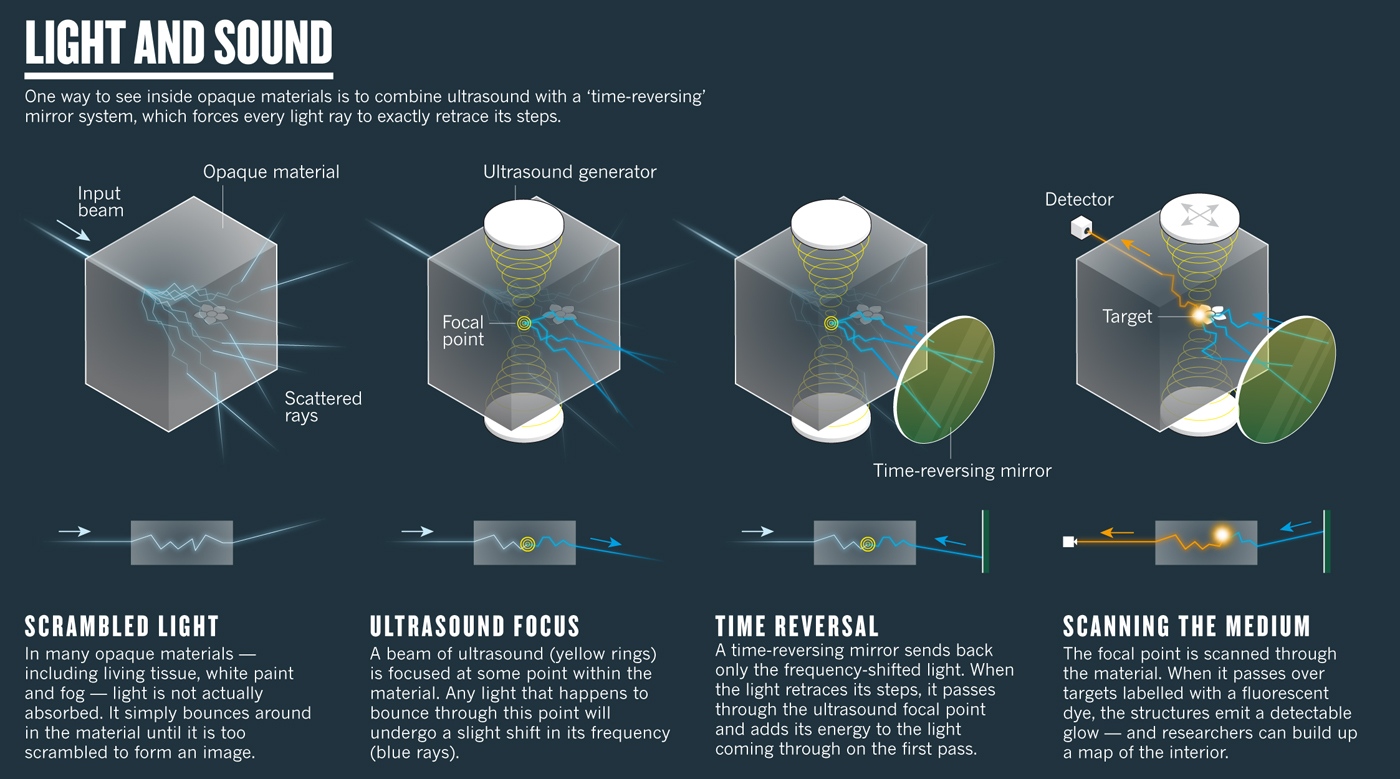
Early experiments were surprisingly successful, producing a concentrated beam a thousand times more intense than the scattered light. Inspired by the results, other teams adjusted the technique to work with focused ultrasonic waves, which shifts the laser light frequency. The shifted rays are then bounced back through the object with a mirror, adding to the energy of the initial beam and creating "a torch inside the wall" (see above). This allowed the team to image a flourescent bead just a micrometer across hidden between two opaque layers."
http://www.engadget.com/2015/02/12/visible-light-super-vision/
...
Early experiments were surprisingly successful, producing a concentrated beam a thousand times more intense than the scattered light. Inspired by the results, other teams adjusted the technique to work with focused ultrasonic waves, which shifts the laser light frequency. The shifted rays are then bounced back through the object with a mirror, adding to the energy of the initial beam and creating "a torch inside the wall" (see above). This allowed the team to image a flourescent bead just a micrometer across hidden between two opaque layers."
http://www.engadget.com/2015/02/12/visible-light-super-vision/