 |
|
| node: | jazda, stredovek a romantika |
| template: | 4 |
| parent: | Bojová technika |
| owner: | al-caid |
| viewed by: | |
| created: | 16.12.2013 - 09:59:58 |
| updated: | 16.12.2013 - 10:50:51 |
|
cwbe coordinatez: 101 63533 2129387 7430728 ABSOLUT KYBERIA |
| permissions | |
| you: | r, |
| system: | public |
| net: | yes |
total descendants::0
total children::0
1 ❤️
The feigned retreat in various combinations, both against men fighting on foot and on horseback, was the most basic and most important tactic used by mounted troops during the Middle Ages. It was widely used also in the ancient world and usually was intended to lure troops fighting on foot from their established positions so that they would be vulnerable to an attack by mounted troops who lacked sufficient fire power to discomfit the enemy so as to force them from their emplacements. The classic example of the feigned retreat used successfully is at Hastings in 1066. Here William's archers, foot soldiers, and horsemen, after firing innumerable volleys of arrows and repeated charges, were unable to break Harold's phalanx.
Thus on two separate occasions during the later stages of this ten to eleven hour battle, the Conqueror's horsemen acted as though they had been routed, broke ranks, and galloped away from the Saxon line in apparent disarray. Some elements of the great fyrd, i.e., general levies who constituted the least well-disciplined elements of Harold's force, deserted the comparative safety of their hilltop position and counterattacked in a pell-mell charge in pursuit of the retreating horsemen. But once the foot soldiers were running full tilt and were thoroughly scattered over the hillside, the horsemen turned on signal and charged the isolated individuals and small groups who were now overmatched in single combat.
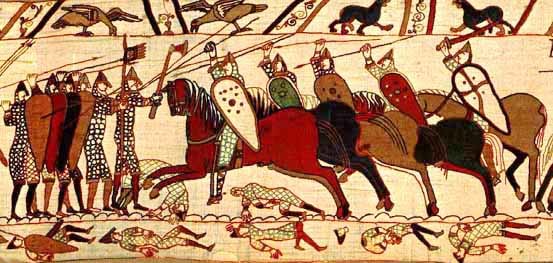
anglosaska hradba vs normansky charge
The tactics that were used effectively by mounted troops, both when they fought on horseback and when they engaged on foot, required great personal discipline as well as the ability to operate effectively in groups. The requirements of medieval battle were the antithesis of the individualistic behavior heralded in the chivalric literature. The more mundane logistic aspects of medieval warfare, without which neither battles in the field nor sieges could occur, required of the military commander (a position to which noble fighting men often aspired) administrative skills and bureaucratic talents that sharply contrast with the impulsive behavior and rash courage so frequently lauded in the poetry of warfare.
How did the medieval fighting man who knew what real warfare required react to the image propagated in the literature of chivalry? Was he somewhat bemused, like the nineteenth-century cowboy who read Ned Buntline comics or the CIA agent who sees James Bond films? Was Roland's kill ratio as absurd to William the Conqueror as John Wayne's inexhaustible six-shooter was to George Patton? I am wont to believe that, then as now, on occasion imagination could suspend reality, but in general I would suspect that chivalric literature was to medieval warfare what the poetry of courtly love was to medieval sex. Honi soit qui mal y pense.
link - http://web.archive.org/web/20110605021909/http://www.deremilitari.org/resources/articles/bachrach3.htm
sucinnost pevnosti s lahkou jazdou v nasich krajoch - http://web.archive.org/web/20110805095116/http://www.deremilitari.org/resources/articles/bowlus.htm
fransky equip - http://web.archive.org/web/20110605021250/http://www.deremilitari.org/resources/articles/coupland.htm
There are currently 9979 K available in
2nd Guild's K-treasury.
get 1 🦆 for 5 🐘
get 1 🐘 for 1 🦆