 |
|
| node: | 17.05.2010-23:57:26 |
| template: | 4 |
| parent: | Ked budem velky, bude zo mna.. |
| owner: | psycho |
| viewed by: | |
| created: | 17.05.2010 - 23:57:26 |
|
cwbe coordinatez: 866 1551575 4651990 5345649 ABSOLUT KYBERIA |
| permissions | |
| you: | r, |
| system: | public |
| net: | yes |
total descendants::0
total children::0
2 ❤️
Engagement and Flow
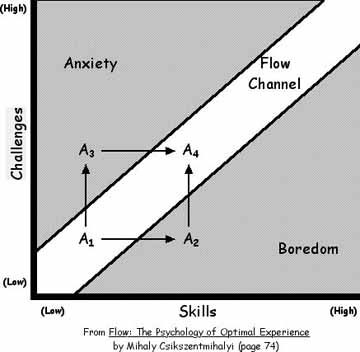
Flow activities lead to growth and discovery. One cannot enjoy doing the same thing at the same level for long. We grow either bored or frustrated; and then the desire to enjoy ourselves again pushes us to stretch our skills, or to discover new opportunities for using them.
"To read remember, understand, synthesise and interpret knowledge is often drudgery. To learn with effectiveness requires repetition, practice and failure."
Why should repetition, practice and failure be equated with drudgery? James Paul Gee notes how in good video games:
Mastery is consolidated through repetition (with variation), only to be challenged again.
Yet gamers play hours on end, repeating the same moves over and over. And this is true, too, of playing sports, music, and chess. Yet, one seldom hears of the repetition in these arenas as drudgery, perhaps hard, perhaps demanding, but not drudgery. In fact, flow can be achieved in something as apparently boring as working on an assembly line. In his book, Csikszentmihalyi recounts the example of Rico:
The task he has to perform on each unit that passes in front of his station should take forty-three seconds to perform—the same exact operation almost six hundred times in a working day. Most people would grow tired of such work very soon. But Rico has been at this job for over five years, and he still enjoys it. The reason is that he approaches his task in the same way an Olympic athlete approaches his event: How can I beat my record? Like the runner who trains for years to shave a few seconds off his best performance on the track, Rico has trained himself to better his time on the assembly line. With the painstaking care of a surgeon, he has worked out a private routine for how to use his tools, how to do his moves. After five years, his best average for a day has been twenty-eight seconds per unit. ... when he is working at top performance the experience is so enthralling that it is almost painful for him to slow down. "It's better than anything else," Rico says. "It's a whole lot better than watching TV." Rico know that very soon he will reach the limit beyond which he will no longer be able to improve his performance at his job. So twice a week he takes evening courses in electronics. When he has his diploma he will seek a more complex job, one that presumably he will confront with the same enthusiasm he has shown so far. (pp. 39-40)
Apparently, it is not repetition or practice per se that is drudgery. Perhaps, in school learning, repetition is not accompanied by variation, and so becomes drudgery. Perhaps, school repetition too often lacks the clear goals and immediate feedback of video games, sports, music, and chess, and so becomes drudgery. We need to find ways of integrating repetition and practice into school learning without them becoming drudgerous.
If we can design learning conditions conducive to flow, perhaps our students will wish to learn.
presne!!
Flow activities lead to growth and discovery. One cannot enjoy doing the same thing at the same level for long. We grow either bored or frustrated; and then the desire to enjoy ourselves again pushes us to stretch our skills, or to discover new opportunities for using them.
"To read remember, understand, synthesise and interpret knowledge is often drudgery. To learn with effectiveness requires repetition, practice and failure."
Why should repetition, practice and failure be equated with drudgery? James Paul Gee notes how in good video games:
Mastery is consolidated through repetition (with variation), only to be challenged again.
Yet gamers play hours on end, repeating the same moves over and over. And this is true, too, of playing sports, music, and chess. Yet, one seldom hears of the repetition in these arenas as drudgery, perhaps hard, perhaps demanding, but not drudgery. In fact, flow can be achieved in something as apparently boring as working on an assembly line. In his book, Csikszentmihalyi recounts the example of Rico:
The task he has to perform on each unit that passes in front of his station should take forty-three seconds to perform—the same exact operation almost six hundred times in a working day. Most people would grow tired of such work very soon. But Rico has been at this job for over five years, and he still enjoys it. The reason is that he approaches his task in the same way an Olympic athlete approaches his event: How can I beat my record? Like the runner who trains for years to shave a few seconds off his best performance on the track, Rico has trained himself to better his time on the assembly line. With the painstaking care of a surgeon, he has worked out a private routine for how to use his tools, how to do his moves. After five years, his best average for a day has been twenty-eight seconds per unit. ... when he is working at top performance the experience is so enthralling that it is almost painful for him to slow down. "It's better than anything else," Rico says. "It's a whole lot better than watching TV." Rico know that very soon he will reach the limit beyond which he will no longer be able to improve his performance at his job. So twice a week he takes evening courses in electronics. When he has his diploma he will seek a more complex job, one that presumably he will confront with the same enthusiasm he has shown so far. (pp. 39-40)
Apparently, it is not repetition or practice per se that is drudgery. Perhaps, in school learning, repetition is not accompanied by variation, and so becomes drudgery. Perhaps, school repetition too often lacks the clear goals and immediate feedback of video games, sports, music, and chess, and so becomes drudgery. We need to find ways of integrating repetition and practice into school learning without them becoming drudgerous.
presne!!
There are currently 9987 K available in
2nd Guild's K-treasury.
get 1 🦆 for 5 🐘
get 1 🐘 for 1 🦆