 |
|
| node: | nábeh na prehľad (~ prvá verzia) 1/3 |
| template: | 4 |
| parent: | net-cultures |
| owner: | dusanson |
| viewed by: | |
| created: | 17.01.2008 - 19:02:00 |
| updated: | 17.01.2008 - 19:22:51 |
|
cwbe coordinatez: 866 1551575 2834359 3616277 ABSOLUT KYBERIA |
| permissions | |
| you: | r, |
| system: | public |
| net: | yes |
total descendants::
total children::0
7 ❤️
| || | 0 |
| palino | 0 |
Overview of network art projects 1921-1984
| Year | Event | Venue | Artists | Details | ||
| 1921 | Manuel Maples Arce's first manifesto Actual número 1, appears in Mexico City | Mexico | Estridentistas | Various literature over the period 1921-1927, notable for use of modern communication network imagery (telegraphs, radio, railroad, etc.), particularly in poetry, that responded critically to European futurisms. | ||
| 1922 | "Telephone Paintings" | László Moholy-Nagy |  | |||
| 1955 | Ray Johnson undertakes early mail art activities | New York City | Ray Johnson |    Johnson had a substantial mailing list (of some two hundred art world and poular culture figures) to whom he begins sending moticos, cutouts on black paper resembling modern hieroglyphics. These mail art activities became known as The New York Correspondance School in 1962. | W | |
| 1961 | Planning begins for Fluxus magazine | George Maciunas and Dick Higgins |  Conceived partly in response to the perceived need for a distribution mechanism for artists' work. In 1964 and 1968, Fluxus periodicals Fluxus I and Fluxus II appeared, assembled by Maciunas. The idea of the periodical expaned, offering new and interactive performative-based experiences for the viewer/participant. Fluxus yearbooks, yearboxes, and Fluxkits were also published. | |||
| 1962 | "Utopian Laser Television" manifesto | New York City | Nam June Paik | Proposed a new communications medium based on hundreds of TV channels, with each channel narrowcasting to an audience of those who want it, without regard to the size of the audience. | W | |
| 1962-1963 | Yam Festivals and Yam Festival Delivery Event | New York City metropolitan area | George Brecht and Robert Watts, coordinators | Festivals were a series of events in a "loose format that would make it possible to combine or include an ever-expanding universe of events." In the delivery event, it is announced that th coordinators will "assemble a work and arrange delivery to you or an addressee of your choice." | W | |
| 1962-1963 | Yam Festivals and Yam Festival Delivery Event | New York City metropolitan area | George Brecht and Robert Watts, coordinators | Festivals were a series of events in a "loose format that would make it possible to combine or include an ever-expanding universe of events." In the delivery event, it is announced that th coordinators will "assemble a work and arrange delivery to you or an addressee of your choice." | W | |
| 1968 | Dial-a-Poem | New York City | John Giorno |  Answering machines function as a venue for "randomly accessible creative expression." | W | |
| 1968 | Art by Telephone exhibition | Museum of Contemporary Art, Chicago | Siah Armajani, Richard Artschwager, John Baldessari, Iain Baxter, Mel Bochner, Geoge Brecht, Jack Burnham, James Lee Byars, Robert H. Cumming, Francoise Dallegret, Jan Dibbets, John Giorno, Robert Grosvenor, Hans Haacke, Richard Hamilton, Dick Higgins, Davi Det Hompson, Robert Huot, Alani Jacquet, Ed Kienholz, Joseph Kosuth, Les Levine, Sol LeWitt, Robert Morris, Bruce Nauman, Claes Oldenburg, Dennis Oppenheim, Richard Serra, Robert Smithson, Guenther Uecker, Stan Van Der Beek, Bernar Venet, Frank Lincoln, Viner Wolf Vostell, William Wegman, William T. Wiley |  Shortly after its opening, the Museum of Contemporary Art planned an exhibition to record the trend, incipient then and pervasive today, toward conceptualization of art. This exhibition, scheduled for the spring of 1968 and abandoned because of technical difficulties, consisted of works in different media, conceived by artists in this country and Europe and executed in Chicago on their behalf. The telephone was designated the most fitting means of communication in relaying instructions to those entrusted with fabrication of the artists' projects or enactment of their ideas. To heighten the challenge of a wholly verbal exchange, drawings, blueprints or written descriptions were avoided. -Jan van der Marck | W | |
| 1969 | Omnibus News appears | based in Munich | Contributors from eight countries; Thomas Niggl, Christian d'Orville, and Heimrad Prem, editors |  Interested individuals are invited to submit copies of their single-page contributions, which were accepted with no editing or censorship. The contributors were then assembled into a periodical of approximately 200 bond pages. Copies were distributed back to artists and via other channels. | ||
| 1969 | Telex art | Canada | N.E. Thing Co., Ltd. (Iain and Ingrid Baxter) | Registered "company" used telex to establish a "virtual identity" as well as to send instructions to remote galleries and museums on how to set up its pieces. | ||
| Sep 1969 | Prototype of the Internet (ARPANET) successfully tested | University of California at Los Angeles and participating institutions | Researchers and scientists at the participating institutions |  Development of interface message processors allows different remote systems and programs to communicate with one another. (The ARPA in ARPANET ws the Advanced Research Projects Agency of the Department of Defense.) | W | |
| Jan 1969-Jul 1994 | Duration Piece No. 13 | primarily U.S. | Douglas Huebler | One hundred one dollar notes were circulated accompanied by a letter saying that anyone sending the note back to Huebler will receive $1,000 in return. | ||
| 1969 | Wipe Cycle | Howard Wise Gallery in New York City | Frank Gillette and Ira Schneider |  First exhibited at the Howard Wise Gallery in New York in 1969 ("TV as a Creative Medium?"). It consisted of nine monitors whose displays were controlled by synchronized cycle patterns of live and delayed feedback, broadcast television, and taped programming shot by Gillette and Schneider with portable equipment. These were displayed through alternations of four programmed pulse signals every two, four, eight, and sixteen seconds. Separately, each of the cycles acted as a layer of video information, while all four levels in concert determined the overall composition of the work at any given moment. | W | |
| 1970 | Labyrinth | Jewish Museum, New York City | Ted Nelson and Ned Woodman | 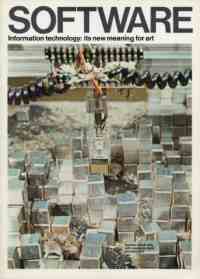 Interactive catalogue for Jack Burnham's Software exhibition. Early hypertext system allowed participants to browse, gather information about the exhibit, then print out an individually profiled search record. | W | |
| 20 Sep-6 Oct 1970 | Ray Johnson: New York Correspondance School exhibition | Whitney Museum of Art | Ray Johnson's New York Correspondance School correspondents; Ray Johnson and Marcia Tucker, cocurators | Exhibition included everything sent to the museum in response to an invitation Johnson sent out to his correspondents. | ||
| 1970-1971 | Notebook I (1970) and Space Atlas (1971) appear | U.S. and Canada | Dana Atchley, editor |  Described as "community notebooks assembling." The first of these periodicals contains works by 60 contributors; the second comprise 120, from seven countries. Copies of each were distributed evenly among contributors. | W | |
| 1970 | Conspiracy 8 | Guggenheim Museum, New York City - MIT, Boston | Gordon Mumma |  Collaborative project by Mumma and Stephen Smoliar, then a doctoral candidate in applied mathematics at the MIT. The present recording documents it's February 20, 1970, premiere at the Artificial Intelligence Laboratory of MIT, with Mumma performing on a bowed musical saw processed sporadically with cybersonics, and Smoliar at the audible teletype console, communicating in real time with a large PDP-6 computer. | W | |
| 1970-1971 | Notebook I (1970) and Space Atlas (1971) appear | U.S. and Canada | Dana Atchley, editor | Described as "community notebooks assembling." The first of these periodicals contains works by 60 contributors; the second comprise 120, from seven countries. Copies of each were distributed evenly among contributors. | W | |
| 1971 | NET manifesto published | originated in Poland | Jaroslaw Kozlowski (a director of an alternative gallery) and Andrzej Kostolowski (a critic), authors |  Outlined as a new strategy of networking for artists in which an open strategy of networking is central. Mailed to 189 international artists, who are invited to be cocurators of the proposed NET. Reissued in 1972. | W | |
| 1971-1972 | Town Fool Project | Victoria, British Columbia, Canada | Anna Freud Banana |  Tables set up at local gatherings combining parody with market systems. Included distributing degrees in Bananalogy, via mail art networks, and playful network dramas about buying and selling. | W | |
| 1971-1972 | Town Fool Project | Victoria, British Columbia, Canada | Anna Freud Banana | Tables set up at local gatherings combining parody with market systems. Included distributing degrees in Bananalogy, via mail art networks, and playful network dramas about buying and selling. | W | |
| 1972 | Media Suitcase installation | documentas, Kassel, Germany | Gottfried Bechtold | Collection of various media, ranging from photography and slide through to Super8 and unrecorded videotape; buyers were directed to use the videotape for filming, thereby extending the archive. | ||
| 1973 | Aloha From Hawaii via satellite | Hawaii | Elvis Presley | First music concert broadcast live via satellite around the world. | ||
| 1974-1982 | Advertisements for creation of artificial aurora borealis | Brazilian and U.S. publications | Paulo Bruscky | Ads placed in newspapers to circulate and document a proposed project to create an artificial aurora borealis, using airplanes to color cloud formations. | ||
| 29 Dec 1976 | Seven Thoughts | Houston Astrodome | Douglas Davis | With the support of the Contemporary Arts Museum in Houston, Douglas Davis performs "Seven Thoughts" in the empty Houston Astrodome. Davis: "In the last ten minutes of this 30-minute piece, I spoke up from the floor of the dome to the orbiting satellite above and sent the thoughts, one by one, to every IntelSat station on earth. It was probably the first use of the satellite by a single person for artmaking purposes. To the best of my knowledge only one nation, india, allowed the thoughts to be heard over radio. But the point was not to reach a big audience. The point was to do it at all...And let the news get out (that long-distance broadcasting was not an exclusive preserve of tv networks, armies, and governments)." | W | |
| 1977 | Happening promoted through mail art | Ricerche Inter/Media Centro Autogestito di Attivita Espressive, Ferrara, Italy | Paulo Bruscky | 27 citizens of Ferrara received by mail a section of a work by Bruscky, divided into 27 parts, to be reassembled by the recipients. | ||
| 1977 | Satellite Arts (The Image as Place) | U.S. East and West Coasts, linked via NASA satellite | Kit Galloway, Sherrie Rabinowitz and Mobilus dancers | 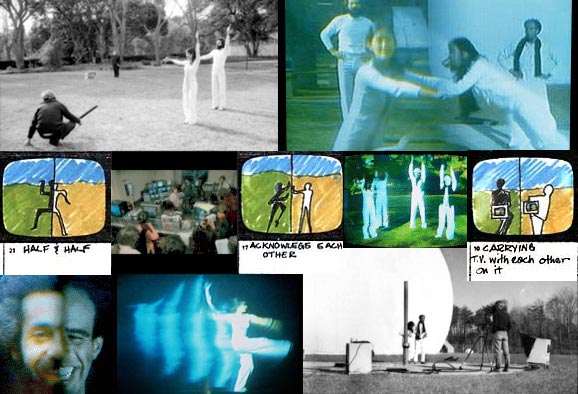 The first use of audiovisual composite imaging for a performance-based telecommunications telecollaboration and an emulation of immersive and virtual-image space/place. Two groups of dancers in two outdoor locations three thousand miles apart were linked, over four days, in a performance space "with no geographical boundaries". | W | |
| 1977 | Flyer circulated soliciting artists' work for new assembling magazine, Commonpress | Varied with participants | Various; Pawel Petasz, central coordinator of issues | Further development in models of participatory publishing, with participants each taking a turn at collecting materials, editing, printing and distributing issues, at their own expense. More than 60 issues were published between 1977 and 1990. | ||
| 1977 | Early performance of networked computer music | Mills College, Oakland, California | Jim Horton, Rich Gold | KIM computers linked together for a performance in which Gold interacted with his artificial-language program while Horton ran an early algorithmic piece. | ||
| Feb 1977 | Four places two figures one ghost | Whitney Museum of Arts | Douglas Davis | A performance "which was simultaneously cablecast to a large live audience outside the walls of the museum". | ||
| 24 Jul 1977 | The Last Nine Minutes | Documenta 6, Kassel | Douglas Davis, Nam June Paik, Joseph Beuys | 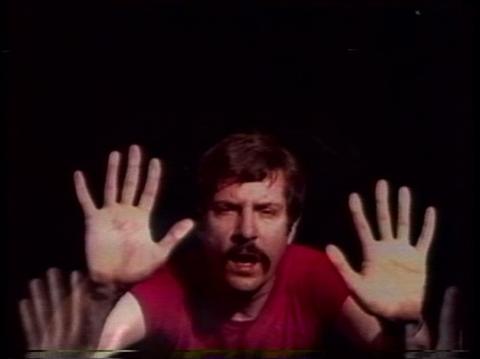 Live performance for international satellite telecast. This performance, presented for German TV's first live satellite transmission marking the opening of the Documenta VI in Kassel, is a continuation of Douglas Davis' works on telecommunication. His exhortations of the viewers to establish contact with him via the TV screen are made all the more pointed by the physical distance between two continents. Davis was preceded by two 10-minute performances by Nam June Paik and Joseph Beuys respectively. Broadcasted by West German TV to many countries, including the USSR. | W | |
| 10-11 Sep 1977 | Two-Way-Demo: Send/Receive | New York City - San Francisco | Liza Bear, Keith Sonnier, Willoughby Sharp |  The live 2.5-hour broadcast between New York and San Francisco. Put into position in 1976, the NASA Satellite CTS is used for the occasion. The New York-based station, MCTV, receives a cable signal by satellite. Other participating artists included Andy Horowitz (alongside the organizers on the East Coast), and Sharon Grace, Carl Loeffler and Terry Fox on the West Coast. The broadcast consisted of discussion and debate, readings, and prerecorded video footage. The broadcast reaches almost 25,000 spectators. | W | |
| 1977 | WorldPool | Toronto - New York City | Norman White, Judith Doyle, Willoughby Sharp |  Experiments with fax exchanges. | W | |
| 1978 | Duo for KIMs developed | - | Jim Horton, John Bischoff | Occasional tones of one machine caused other to transpose its melodic activity accordingly. | ||
| 1978 | "The Form: 1970-1979" distributed | Palo Alto, California; Union City, California; Mills College Art Gallery Oakland, California | Melody Sumner Carnahan, Michael Sumner; participants included Richard Kostelanetz, Andy Warhol, John Cage, Ed Ruscha, John Baldessari, Ruby Ray, Dick Higgins, Throbbing Gristle, and Vito Acconci | Form comprising a list of the years 1970-1979, each followed by a blank line was distributed to 100 work colleagues, friends, and relatives, as well as strangers (artists, writers, politicians, etc.) Recipients were asked to fill it in and return it. Completed forms eventually became a book, Form, and were displayed in a 1980 exhibition. | ||
| Spring 1978 | Performance of networked computers | Artist-run space The Blind Lemon, Berkeley, California | Jim Horton, John Bischoff, Rich Gold | Networked trio of computers. Other performances followed. Trio evolved into group, The League of Automatic Music Composers. | ||
| 1978, 1979 | Broadcast of sound poems and sound works by various artists | Recife, Brazil | Paulo Bruscky, initiator; sound works by various artists, including John Cage | Broadcast on mainstream Recife radio station during winter arts festivals. | ||
| 1978 | Open Space Gallery, Victoria, Canada - NYC, Memphis, Toronto, Oakland, Vancouver, San Diego and San Francisco. | Open Space Gallery in Victoria, Canada, conducts several live Slow-Scan video transmissions with other groups of artists in New York City, Memphis, Toronto, Oakland, Vancouver, San Diego and San Francisco. | ||||
| 1978, 1979 | Broadcast of sound poems and sound works by various artists | Recife, Brazil | Paulo Bruscky, initiator; sound works by various artists, including John Cage | Broadcast on mainstream Recife radio station during winter arts festivals. | ||
| Spring 1979 | Biweekly presentations of performances using networked computers | Finnish Hall, Berkeley, California, under auspices of East Bay Center for the Performing Arts | The League of Automatic Music Composers | Presentations over the course of five months offered audience "computer-generated sonic landscapes" and allowed participation by other artists. Following conclusion of this series of presentations members of the group continued to develop the network music form, plaing widely around the Bay Area. | ||
| 1979 | PacRim Slow Scan Project | Vancouver | Bill Bartlett, organiser, with other artists | Satellite link via slow-scan and the NASA ATS-1 Peacesat network. | ||
| 1979 | "Interplay" computer communications conference | Toronto, Vienna | Bill Bartlett (Toronto), Robert Adrian X, Richard Kriesche, Heidi Grundmann, and Gottfried Bach (Vienna) | Studio at Austrian TV is set up and news is read live in a radio program transmission, Art Today. | ||
| 1979 | Audio Scene 79 | Modern Art Galerie, Vienna | ||||
| Early 1980s | Banana Rag begins operating as mail art forum and news source zine | Vancouver, British Columbia, Canada | Anna Freud Banana | Hand-drawn and -printed periodical distributed via mail networks. Associated with mail art network. | W | |
| 1980 | Hole-in-Space, A Public Communication Sculpture | New York (Lincoln Center) - Los Angeles (Broadway department store, Century City) | Kit Galloway, Sherrie Rabinowitz | 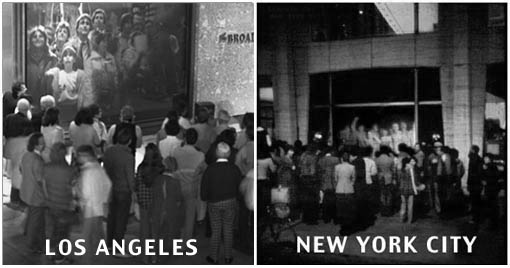 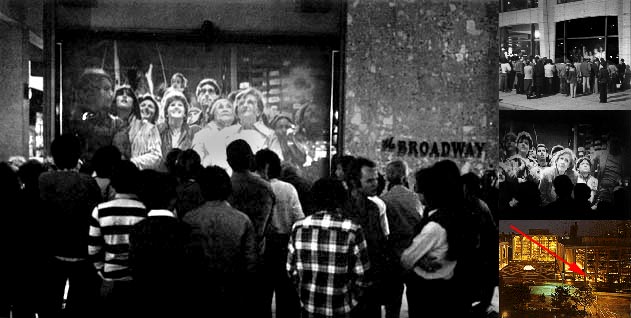 Live satellite communications were used over three days to create a new social space linking public on the streets of the two citis, each interacting with the public in the other city via screens in shop windows. | W | |
| 16 Feb 1980 | Artists' Use of Telecommunications Conference | CAMBRIDGE (USA): Center for Advanced Visual Studies/M.I.T. (Aldo Tambellini etc.) HAWAII: University Art Department (John Southworth etc.) JAPAN: Tsukuba University (Michael Goldberg etc.) NEW YORK: 1. Alternative Media Center/New York City University (Douglas Davis, Martin Neisenholtz etc.) 2. Center for New Art Activities (Willoughby Sharp, Lisa Bear) SAN FRANCISCO: La Mamelle & San Franscisco Museum of Modern Art (Bill Bartlett, Carl Loeffler (Org.) with Liza Bear, Sharon Grace, Gene Youngblood) TORONTO: Trinity Video and Ontario College of Art (Norman White etc.) VANCOUVER: Western Front Society (Hank Bull, Kate Craig, Glen Lewis etc.) VICTORIA (Canada): I.P. Sharp Ass. (Mike Powell etc.) VIENNA: Museum des 20. Jahrhunderts (Robert Adrian, Grita Insam (Org.) with Ernst Caramelle, Valie Export, Karl Kowanz, Richard Kriesche, Helmut Mark & Peter Weibel.) | Organised by Bill Bartlett and Carl Loeffler | 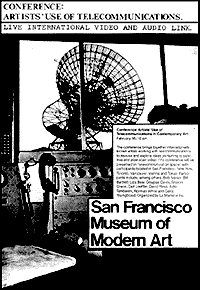 Participants in Vienna, Tokyo, Vancouver, Hawaii, New York, Boston, and San Francisco were brought together using IP Sharp APL Timesharing System and either a worldwide teleconference linkup or slow-scan TV and Audiolink. | W | |
| 1980-1981 | Publication of periodical Artforum begins | Poland | Various contributors to each issue and Pawel Petasz | Contributors to this magazine of mail art and ephemeral art receive issues consisting of a single sheet of homemade paper on which is typed a "table of contents" listing the submissions that have gone into the issue-literally, in this case, as Petasz pulps the contributions and produces the paper on which the contents list of printed. The print run for each issue is determined by the number and size of contributions. Title is a play on that of the influential art world publication, Art Forum. | ||
| 31 Oct 1981 | Artistic fax transmission | Recife and Sao Paulo, Brazil | Paulo Bruscky, Roberto Sandoval | Transmission took place between Broscky in Recife and Sandoval in Sao Paulo. Documentation of transmission was exhibited in Arte Novos Meios/Multimedios (New Media/Multimedia Art), FAAP, Sao Paulo, 1985. Other fax performances incorporated Bruscky's earlier electrocardiogram "drawings," etc. | ||
| 1980-1981 | Publication of periodical Artforum begins | Poland | Various contributors to each issue and Pawel Petasz | Contributors to this magazine of mail art and ephemeral art receive issues consisting of a single sheet of homemade paper on which is typed a "table of contents" listing the submissions that have gone into the issue-literally, in this case, as Petasz pulps the contributions and produces the paper on which the contents list of printed. The print run for each issue is determined by the number and size of contributions. Title is a play on that of the influential art world publication, Art Forum. | ||
| 1981 | Paper Tiger Television appears on Manhattan cable | Public-access cable channels across the U.S. | Collective comprising artists, activits, and academics, early initiators and participants included Dee Dee Halleck, Diana Agosta, Pennee Bender, Caryn Rogoff, Shu Lea Chang, Martha Wallner, and Tuli Kupferberg; critics presented included Herb Schiller, Jo | On a shoestring budget, half-hour critiques of mainstream media programming were shot and tapes distributed to supporters in carious U.S. cable systems for playback. Copies found their way to several dozen public-access stations in different locales. | ||
| 1981 | Negativland begins broadcasting its audio collage weekly on Over the Edge | KPFA-FM, Berkeley, California | Don Joyce and other group members | Diverse radio practice featuring range of sonic materials and repurposing of found sound, for which the group was sued in 1991, under copyright law. | ||
| 1974-1982 | Advertisements for creation of artificial aurora borealis | Brazilian and U.S. publications | Paulo Bruscky | Ads placed in newspapers to circulate and document a proposed project to create an artificial aurora borealis, using airplanes to color cloud formations. | ||
| 1982 | Radio Polybucket open | Tokyo | Tetsuo Kogawa and others | The earliest mini-FM station in Japan. Evolved into Radio Home Run, which broadcast until 1996, then was reactivated as an Internet radio station, Net.RadioHome Run. | ||
| 27-28 Sep 1982 | Telematic event: "The World in 24 Hours" | Linz (Ars Electronica) and other 15 cities | Robert Adrian X |  Electronic networking event in the Upper Austrian regional studio in Linz. Artists in 16 cities on three continents were linked for 24 hours. | W | |
| 11-23 Dec 1983 | La Plissure du Texte: A Planetary Fairytale | In the exhibition Electra: Electricity and Electronics in the Art of the Twentieth Century, Musee Art Moderne de la Ville de Paris | Roy Ascott and artists participating in 11 cities in Europe, North America, and Australia, Frank Popper, curator |  Collaborative storytelling project involving computer conferencing network of artists using ARTEX, an electronic-mail program. Project was active on-line 24 hours a day for 12 days. Several authors in various countries were working on an interactive "planetary fairy-tale". Every day the computer terminal disgorged the contributions of the other characters and it was up to each node to formulate a response that would further thicken the plot and send it out on the E-mail net. Visitors to the exhibition Electra, which was organized at the Musée d'Art Moderne de la Ville de Paris in 1983, were able to witness the production of a text on screens connected to the authors' computer terminals. | W | |
| 1983-1984 | Answering machine "site" | Burning Books, San Francisco | Patrick Sumner and others, including Jon Livingston, Michael Peppe, and Sheila Davies | A short, specially commissioned audio work was made available to those who dialed the number provided on a series of 12 postcards distributed to advertise the site; each week, a different work was offered. | ||
| 1983 | Contact | Tel-Aviv | Natan Karczmar | "projet utilisant un réseau de vingt-quatre postes téléphoniques" | ||
| 1983-1984 | Answering machine "site" | Burning Books, San Francisco | Patrick Sumner and others, including Jon Livingston, Michael Peppe, and Sheila Davies | A short, specially commissioned audio work was made available to those who dialed the number provided on a series of 12 postcards distributed to advertise the site; each week, a different work was offered. | ||
| 1984 | Electronic Cafe-84 | Five Los Angeles restaurants, Los Angeles Olympic Arts Festival, Los Angeles. Museum of Contemporary Art | Kit Galloway, Sherrie Rabinowitz | A multimedia, telecollaborative network was created among five family-owned restaurants (in Los Angeles Korean, Hispanic, African and beach communities). Venues were lined using a variety of technologies, including slow-scan, phone link video systems; electronic writing tablets; computers; printers; and video screens. First public use of a storage-and-retrieve pictorial database. | ||
| 1984 | Cyborg | - | Eduardo Kac | Kac's first telepresence project was to involve three different Rio de Janeiro art galleries and the remote control of sculptural objects. Not realized, as a result of technical obstacles. | ||
| 1984-1985 | Hearsay | Toronto | Norman White | Multiple text transmission. | ||