cwbe coordinatez:
101
63535
21
1476868

ABSOLUT
KYBERIA
permissions
you: r,
system: public
net: yes

neurons

stats|by_visit|by_K
source
tiamat
K|my_K|given_K
last
commanders
polls

total descendants::
total children::4
5 ❤️


show[ 2 | 3] flat


terorrist0
runway0
liryc0
zona central...0


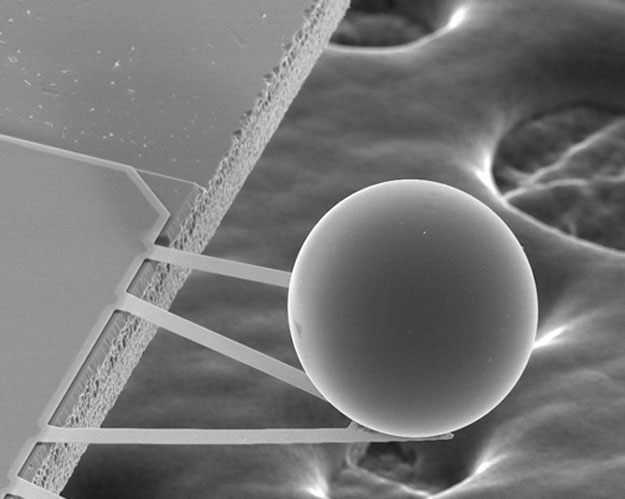
Explanation: This tiny ball provides evidence that the universe will expand forever. Measuring slightly over one tenth of a millimeter, the ball moves toward a smooth plate in response to energy fluctuations in the vacuum of empty space. The attraction is known as the Casimir Effect, named for its discoverer, who, 50 years ago, was trying to understand why fluids like mayonnaise move so slowly. Today, evidence is accumulating that most of the energy density in the universe is in an unknown form dubbed dark energy. The form and genesis of dark energy is almost completely unknown, but postulated as related to vacuum fluctuations similar to the Casimir Effect but generated somehow by space itself. This vast and mysterious dark energy appears to gravitationally repel all matter and hence will likely cause the universe to expand forever. Understanding vacuum fluctuations is on the forefront of research not only to better understand our universe but also for stopping micro-mechanical machine parts from sticking together.


0000010100063535000000210147686801476877
crowd​ control
 crowd​ control      09.03.2005 - 03:05:50 , level: 1, UP   NEW


Explanation: Despite clouds and rain showers astronomer Phillip Perkins managed to spot a reddened, eclipsed Moon between the stones of this well known monument to the Sun during May's total lunar eclipse, from Stonehenge, England. When he recorded this dramatic picture, the rising Moon was only about 5 degrees above the horizon, but conveniently located through a gap in the circle of ancient stones. Although at first glance there appears to be an eerie, luminous pool of water in the foreground, Perkins notes that his daughter produced the artistic lighting effect. She illuminated a fallen stone and surrounding grass with a flashgun from her hiding place behind the large sarsen stone to the right of center. As the picture looks toward the southeast, the stone just below the Moon is one of the inner bluestones rather than the famous Heel Stone, which marks the northeast direction of the summer solstice sunrise.

0000010100063535000000210147686801476875
crowd​ control
 crowd​ control      09.03.2005 - 03:03:18 , level: 1, UP   NEW


These two mighty galaxies are pulling each other apart. Known as "The Mice" because they have such long tails, each spiral galaxy has likely already passed through the other. They will probably collide again and again until they coalesce. The long tails are created by the relative difference between gravitational pulls on the near and far parts of each galaxy. Because the distances are so large, the cosmic interaction takes place in slow motion -- over hundreds of millions of years. NGC 4676 lies about 300 million light-years away toward the constellation of Coma Berenices and are likely members of the Coma Cluster of Galaxies. The above picture was taken with the Hubble Space Telescope's Advanced Camera for Surveys which is more sensitive and images a larger field than previous Hubble cameras. The camera's increased sensitivity has imaged, serendipitously, galaxies far in the distance scattered about the frame.

0000010100063535000000210147686801476873
crowd​ control
 crowd​ control      09.03.2005 - 03:00:20 , level: 1, UP   NEW


Explanation: Staring across interstellar space, the alluring Cat's Eye nebula lies three thousand light-years from Earth. A classic planetary nebula, the Cat's Eye (NGC 6543) represents a final, brief yet glorious phase in the life of a sun-like star. This nebula's dying central star may have produced the simple, outer pattern of dusty concentric shells by shrugging off outer layers in a series of regular convulsions. But the formation of the beautiful, more complex inner structures is not well understood. Seen so clearly in this sharp Hubble Space Telescope image, the truly cosmic eye is over half a light-year across. Of course, gazing into the Cat's Eye, astronomers may well be seeing the fate of our sun, destined to enter its own planetary nebula phase of evolution ... in about 5 billion years.

0000010100063535000000210147686801476871
crowd​ control
 crowd​ control      09.03.2005 - 02:57:14 , level: 1, UP   NEW


Explanation: In the well known Pleiades star cluster, a star's light is slowly destroying this wandering cloud of gas and dust. Above, the star Merope lies just off the upper left edge of this picture from the Hubble Space Telescope. The cloud, known as IC 349, and the star have been in existence for millions of years. In the past 100,000 years, however, part of the cloud has by chance moved so close to the star - only 3,500 times the Earth-Sun distance - that the starlight itself is having a very dramatic effect. Pressure of the star's light significantly repels the dust in the reflection nebula with smaller dust particles being repelled more strongly. Eventually parts of the dust cloud have become stratified and point toward Merope, with the closest particles being the most massive and so the least affected by the radiation pressure. A longer-term result will be the general destruction of the dust by the energetic starlight.

000001010006353500000021014768680147687101477723
terorrist
 terorrist      09.03.2005 - 12:32:30 , level: 2, UP   NEW


fiha, a to je uz co toto? no ale kde sa ty nachadzas?

00000101000635350000002101476868014768710147772301479350
crowd​ control
 crowd​ control      09.03.2005 - 22:08:49 , level: 3, UP   NEW
wherever I may roam