 |
|
| node: | AF-S DX Nikkor 18-70mm f/3.5-4.5G IF-ED DX |
| template: | 4 |
| parent: | Fototechnika |
| owner: | deadcat |
| viewed by: | |
| created: | 12.01.2005 - 13:33:34 |
|
cwbe coordinatez: 101 63537 758948 1102981 1325689 ABSOLUT KYBERIA |
| permissions | |
| you: | r, |
| system: | public |
| net: | yes |
total descendants::
total children::1
thnx 2 epxd za clanok = recenziu objektivu ale obsahuje aj uzitocne rady tak ho sem cely pastnem nak sa vam - koho zaujima - dobre cita...
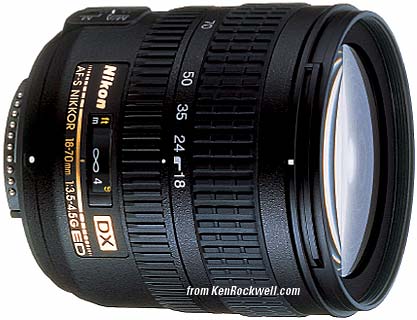
This lens was introduced along with the D70 in February 2004. It is the best choice wide to tele zoom lens for every Nikon digital SLR. It can be gotten for $360 alone or as part of a package with a D70 for an additional $300. Obviously if you are getting a D70 then get the kit.
The only reason not to get this unique lens is if you prefer to pay $1,000 and get the superb 12-24 mm lens and a tele instead. The 18-70 is still the best mid range zoom if you still wanted a third lens.
This is a serious lens, not a "kit lens" or a cheap replacement for a lens cap sold as part of a kit as with most other cameras. The fast f/3.5 - 4.5 speed should be your clue; the cheapies are all f/3.5 - 5.6.
It works great and is unique in that it's small and and has a huge zoom range starting from a very useful 18mm. It is similar to a 27 - 105mm on a 35mm film camera.
It ONLY works on digital SLRs. Using it on a film camera will result in a semi-circular image with dark corners. If you need a wide angle zoom for a film camera you need the 18-35 instead.
It's an easy to use, sharp, compact and all around nice lens. I've shot with it, love it and bought one for myself. It's pretty much identical in size, feel and weight to the 24-85 AFS I use for my film cameras but with a much more useful focal range for digital cameras.
SPECIFICATIONS
15 elements, 13 groups, one of which is an aspheric. This is not a "kit" cheapie lens.
2.9" (73mm) long by 3" (74mm) long, 14 oz (390 g)
Seven-bladed rounded diaphragm, f/22 - 36 minimum aperture
Close focus 15" or 0.38m, very good.
67mm filter thread.
I suggest permanently attaching a 67 -> 77mm step-up ring and treating this lens as if it's got a 77mm thread just like the rest of Nikon's pro lenses. This way you only need one size of caps and filters and other accessories. Trust me, you'll go insane if you buy different filters for every lens! No, you can't use the lens hood this way; I never use lens hoods so no problem. I just use my hand to block the light of the sun if it's shining directly into the lens, which works a lot better than the hood when you need it.
PERFORMANCE
It's sharp, focuses fast and silently and has instant manual focus override like all AF-s lenses. The distortion is fairly typical: barrel at wide, neutral in the middle and some pincushion at the tele end.
Some people worry too much about sharpness. On a digital camera you get up to a certain spatial frequency and the MTF drops to zero thanks to the antialiasing filter and the CCD layout, thus it's much easier to characterize lenses for digital cameras. Sharpness is easy to get on digital camera lenses and this is as sharp as it can be. Nikon posts the MTF curves at the bottom of this page.
Discount lens makers are trying to scare people into thinking that they just invented magical "digital" lenses in an attempt to make people think that the discount lenses somehow outdo the existing lenses you already own. Nope. Your 15 year old AF lenses are just great on a digital camera.
Film lenses are trickier since the MTF curve extends, albeit at a very low amplitude, to triple digit c/mm. Digital cameras stop at about 30 c/mm.
This lens is completely sharp. Go for it.
Distortion:
18 mm: barrel with somewhat complex signature, probably will require some cleverness to correct with the "Spherize " command in Photoshop. It sort of bloats in the middle and straightens towards the far edges. If you need no distortion at this focal length use the 12-24mm, or use the free Panorama Tools Photoshop to correct this distortion electronically. Like most wide range zooms this 18-70 will curve some straight lines parallel and close to the frame edges when set fully wide.
25 mm: none
28 mm: none
35 mm: almost no pincushion
50 mm: very minor pincushion
70 mm: very minor pincushion
Flare and Ghosts
Shooting straight into bright lights I saw none, which is great.
Zooming
The zoom ring is a little nonlinear and constricted towards the wide end. This means that you have to be careful moving the zoom ring at the wide end since small changes in rotation result in larger changes in focal length. At the tele end you can make very precise adjustments.
Note to techies: when I say linear I mean logarithmic, of course. An equal amount of rotation anyplace gives the same percentage change in focal length.
Is this the best lens?
I often get questions from new photo hobbyists like "I have priced the Sigma 24-70 f/2.8 and it is the same price as the Nikkor 18-70 f/3.5-4.5G that comes with the D70. Should I buy it instead of the Nikkor? I am not sure of the importance of the extra .7 f-stop vs. the extra 6mm on the wide angle side."
Actually, the answer lies on both the surface and substance level.
At the surface level understood by the new photographer this answer is easy: the 2/3 of a stop means nothing today, since you can just increase the ISO of the D70 with little to no penalty in image quality if you run out of light. On the other hand, the 7 mm is a HUGE difference in how wide it goes on the D70: it's the difference between a 27 mm lens and a 36 mm lens on a 35 mm film camera. You will always be at the 24 mm stop and wishing you could get back out to 18 mm on the D70 for a lot of things, at least the way I use it. This is quite clear.
The substance level is something I never appreciated till I had a couple of decades of experience under my belt. A discount lens usually offers more features like faster speed or wider zoom range for less money than camera-brand lenses. Likewise, a cheap car like a Hyundai or Ford usually offers better specifications, like fuel economy, horsepower or number of radio presets, for a lower price than a Mercedes. You may realize that the Mercedes has a lot more fundamental quality for which there is no numeric specification, and so you probably understand why a Mercedes costs more even with worse specifications.
It's the same thing with lenses. Discount brands are usually pushed by camera stores because they make even more money selling them (more here on that). I avoid the discount brands and know of no professional photographer who uses them. Don't you think if even one pro photographer you'd heard of used them they'd push that in their ads? Anyway, the discount lenses cut corners in places that neophytes don't know about, like the internal construction quality. I find them to be a bad deal, but hey, get what you want.
SUMMARY & FINAL SUGGESTIONS
Buy one, I did!
Unlike for film cameras where there are at least a dozen wide to tele zooms available new and used, the only other choice for digital SLRs is the much more expensive, heavy and restricted zoom range Nikkor 17 - 55 mm lens. Even at the same price I would prefer to give up a fraction of a stop because digital cameras, unlike film, look great at high ISOs and I prefer the more extended zoom range and lighter weight of the 18-70. Of course if you have the need to impress the innocent by having a tough looking camera by all means go get the 17-55.
This is an easy choice.
This lens was introduced along with the D70 in February 2004. It is the best choice wide to tele zoom lens for every Nikon digital SLR. It can be gotten for $360 alone or as part of a package with a D70 for an additional $300. Obviously if you are getting a D70 then get the kit.
The only reason not to get this unique lens is if you prefer to pay $1,000 and get the superb 12-24 mm lens and a tele instead. The 18-70 is still the best mid range zoom if you still wanted a third lens.
This is a serious lens, not a "kit lens" or a cheap replacement for a lens cap sold as part of a kit as with most other cameras. The fast f/3.5 - 4.5 speed should be your clue; the cheapies are all f/3.5 - 5.6.
It works great and is unique in that it's small and and has a huge zoom range starting from a very useful 18mm. It is similar to a 27 - 105mm on a 35mm film camera.
It ONLY works on digital SLRs. Using it on a film camera will result in a semi-circular image with dark corners. If you need a wide angle zoom for a film camera you need the 18-35 instead.
It's an easy to use, sharp, compact and all around nice lens. I've shot with it, love it and bought one for myself. It's pretty much identical in size, feel and weight to the 24-85 AFS I use for my film cameras but with a much more useful focal range for digital cameras.
SPECIFICATIONS
15 elements, 13 groups, one of which is an aspheric. This is not a "kit" cheapie lens.
2.9" (73mm) long by 3" (74mm) long, 14 oz (390 g)
Seven-bladed rounded diaphragm, f/22 - 36 minimum aperture
Close focus 15" or 0.38m, very good.
67mm filter thread.
I suggest permanently attaching a 67 -> 77mm step-up ring and treating this lens as if it's got a 77mm thread just like the rest of Nikon's pro lenses. This way you only need one size of caps and filters and other accessories. Trust me, you'll go insane if you buy different filters for every lens! No, you can't use the lens hood this way; I never use lens hoods so no problem. I just use my hand to block the light of the sun if it's shining directly into the lens, which works a lot better than the hood when you need it.
PERFORMANCE
It's sharp, focuses fast and silently and has instant manual focus override like all AF-s lenses. The distortion is fairly typical: barrel at wide, neutral in the middle and some pincushion at the tele end.
Some people worry too much about sharpness. On a digital camera you get up to a certain spatial frequency and the MTF drops to zero thanks to the antialiasing filter and the CCD layout, thus it's much easier to characterize lenses for digital cameras. Sharpness is easy to get on digital camera lenses and this is as sharp as it can be. Nikon posts the MTF curves at the bottom of this page.
Discount lens makers are trying to scare people into thinking that they just invented magical "digital" lenses in an attempt to make people think that the discount lenses somehow outdo the existing lenses you already own. Nope. Your 15 year old AF lenses are just great on a digital camera.
Film lenses are trickier since the MTF curve extends, albeit at a very low amplitude, to triple digit c/mm. Digital cameras stop at about 30 c/mm.
This lens is completely sharp. Go for it.
Distortion:
18 mm: barrel with somewhat complex signature, probably will require some cleverness to correct with the "Spherize " command in Photoshop. It sort of bloats in the middle and straightens towards the far edges. If you need no distortion at this focal length use the 12-24mm, or use the free Panorama Tools Photoshop to correct this distortion electronically. Like most wide range zooms this 18-70 will curve some straight lines parallel and close to the frame edges when set fully wide.
25 mm: none
28 mm: none
35 mm: almost no pincushion
50 mm: very minor pincushion
70 mm: very minor pincushion
Flare and Ghosts
Shooting straight into bright lights I saw none, which is great.
Zooming
The zoom ring is a little nonlinear and constricted towards the wide end. This means that you have to be careful moving the zoom ring at the wide end since small changes in rotation result in larger changes in focal length. At the tele end you can make very precise adjustments.
Note to techies: when I say linear I mean logarithmic, of course. An equal amount of rotation anyplace gives the same percentage change in focal length.
Is this the best lens?
I often get questions from new photo hobbyists like "I have priced the Sigma 24-70 f/2.8 and it is the same price as the Nikkor 18-70 f/3.5-4.5G that comes with the D70. Should I buy it instead of the Nikkor? I am not sure of the importance of the extra .7 f-stop vs. the extra 6mm on the wide angle side."
Actually, the answer lies on both the surface and substance level.
At the surface level understood by the new photographer this answer is easy: the 2/3 of a stop means nothing today, since you can just increase the ISO of the D70 with little to no penalty in image quality if you run out of light. On the other hand, the 7 mm is a HUGE difference in how wide it goes on the D70: it's the difference between a 27 mm lens and a 36 mm lens on a 35 mm film camera. You will always be at the 24 mm stop and wishing you could get back out to 18 mm on the D70 for a lot of things, at least the way I use it. This is quite clear.
The substance level is something I never appreciated till I had a couple of decades of experience under my belt. A discount lens usually offers more features like faster speed or wider zoom range for less money than camera-brand lenses. Likewise, a cheap car like a Hyundai or Ford usually offers better specifications, like fuel economy, horsepower or number of radio presets, for a lower price than a Mercedes. You may realize that the Mercedes has a lot more fundamental quality for which there is no numeric specification, and so you probably understand why a Mercedes costs more even with worse specifications.
It's the same thing with lenses. Discount brands are usually pushed by camera stores because they make even more money selling them (more here on that). I avoid the discount brands and know of no professional photographer who uses them. Don't you think if even one pro photographer you'd heard of used them they'd push that in their ads? Anyway, the discount lenses cut corners in places that neophytes don't know about, like the internal construction quality. I find them to be a bad deal, but hey, get what you want.
SUMMARY & FINAL SUGGESTIONS
Buy one, I did!
Unlike for film cameras where there are at least a dozen wide to tele zooms available new and used, the only other choice for digital SLRs is the much more expensive, heavy and restricted zoom range Nikkor 17 - 55 mm lens. Even at the same price I would prefer to give up a fraction of a stop because digital cameras, unlike film, look great at high ISOs and I prefer the more extended zoom range and lighter weight of the 18-70. Of course if you have the need to impress the innocent by having a tough looking camera by all means go get the 17-55.
This is an easy choice.